
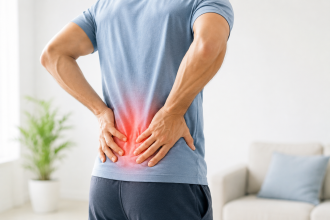
Lumbar disc disease and lumbar disc herniation are common conditions affecting the lumbar spine and may cause lower back pain, sciatica, numbness, tingling, or weakness in the leg. The intervertebral discs are located between the vertebrae and act as flexible cushions, helping to absorb shock and allowing movement of the spine. Over time or following mechanical strain, an intervertebral disc may develop degenerative changes, bulging, or herniation. When disc material irritates or compresses a nerve root, it can cause lumbar radiculopathy, resulting in pain and other neurological symptoms that may extend from the lower back into the leg.
Lumbar Disc Disease and Lumbar Disc Herniation
The terms disc disease and herniated disc are often used together, although they do not describe exactly the same condition. Lumbar disc disease generally refers to degenerative or other changes affecting one or more intervertebral discs of the lumbar spine. A lumbar herniated disc occurs when part of the intervertebral disc material extends beyond its normal boundaries. Depending on the size and location of the herniation, it may irritate or compress a nearby nerve root. Importantly, the presence of disc degeneration or a herniated disc on an MRI does not necessarily mean that it is the cause of the patient’s pain. Similar changes can also be found in people without symptoms. For this reason, imaging findings should always be interpreted in combination with the patient’s symptoms and neurological examination.
Symptoms of Lumbar Disc Disease
The symptoms of lumbar disc disease and disc herniation vary depending on the location and severity of the condition and whether a nerve root is compressed or irritated.
Symptoms may include:
- Lower back pain
- Pain extending into the buttock and leg
- Sciatica
- Numbness or tingling in the leg or toes
- Burning or electric shock-like sensations along the leg
- Muscle weakness in the lower limb
- Difficulty walking in more severe cases
- Worsening of pain with certain movements, coughing, or sneezing
When a nerve root is affected, the distribution of pain, numbness, or weakness can help identify which nerve root may be involved.
Sciatica and Lumbar Radiculopathy
Sciatica usually describes pain that begins in the lower back or buttock and radiates into the lower limb, following the course of the sciatic nerve or the nerve roots that form it. One of the most common causes is a lumbar herniated disc, which can cause compression or inflammatory irritation of a nerve root. Lumbar radiculopathy may cause not only pain but also sensory disturbances, reduced reflexes, or muscle weakness. The presence of objective muscle weakness is a particularly important finding and requires neurological assessment.
Causes and Risk Factors
Intervertebral discs undergo natural changes with age. Their water content and elasticity may gradually decrease, making them more susceptible to degenerative changes.
Factors that may be associated with an increased risk of lumbar disc problems include:
- Increasing age and degenerative changes
- Repetitive mechanical strain on the lower back
- Lifting heavy objects using improper technique
- Occupations involving frequent bending or twisting of the trunk
- Prolonged sitting
- Excess body weight
- Smoking
- Genetic predisposition
- Reduced physical activity in some cases
A herniated disc may also occur following a sudden movement or significant mechanical strain, although in many cases there is no specific traumatic event.
Diagnosis of Lumbar Disc Disease and Radiculopathy
The diagnosis of lumbar disc disease and lumbar radiculopathy is initially based on the medical history and a detailed clinical and neurological examination. Particular attention is given to the distribution of pain, the presence of numbness or weakness, and the impact of symptoms on everyday functioning.
Diagnostic evaluation may include:
Neurological examination: Muscle strength, reflexes, sensation, walking, and other functions that may be affected by nerve root compression are assessed.
Lumbar Spine Magnetic Resonance Imaging (MRI): MRI can visualize the intervertebral discs, nerve roots, and other structures of the spine and may identify a herniated disc or another cause of nerve compression.
Electromyography and Nerve Conduction Studies (EMG/NCS): In selected cases, these tests can help confirm radiculopathy, assess its severity, and distinguish it from peripheral neuropathy or other neurological conditions.
Not every patient with lower back pain requires an immediate MRI or electromyography. The need for further investigations is determined by the symptoms and findings of the clinical examination.
Treatment of Lumbar Disc Disease
The treatment of lumbar disc disease and disc herniation is individualized according to the severity of symptoms, the presence of neurological deficits, and imaging findings. In most cases, when serious neurological symptoms are absent, initial treatment is conservative.
Treatment may include:
- Appropriate medication for pain management
- Treatment of neuropathic pain when clinically indicated
- Physiotherapy
- Gradual return to physical activity
- Individualized strengthening and mobility exercises
- Ergonomic adjustments and appropriate body mechanics
Prolonged inactivity is generally not considered the optimal approach. Maintaining an appropriate level of activity, when safe and tolerated, is an important part of recovery. In cases of persistent radicular pain, specialized therapeutic interventions may also be considered.
Indications for Surgical Treatment
Most cases of lumbar disc herniation do not require surgery.
However, surgical evaluation may be necessary when there is:
- Significant or progressive muscle weakness
- Severe and persistent radicular pain despite appropriate conservative treatment
- Significant nerve root compression corresponding to the clinical symptoms
- Severe neurological deficit
- Cauda equina syndrome
The decision regarding surgical treatment is based on a combination of the patient’s symptoms, neurological examination, duration of the condition, and imaging findings.
Symptoms Requiring Immediate Medical Assessment
Certain symptoms in a patient with lower back pain or a herniated disc may indicate significant compression of the neural structures and require urgent medical assessment.
Particular attention is required when there is:
- New or rapidly worsening weakness in one or both legs
- Loss of bladder or bowel control
- Difficulty initiating urination or urinary retention
- Numbness around the genitals, perineum, or anal area
- Severe difficulty walking
- Severe pain following significant trauma
- Lower back pain accompanied by fever or other significant systemic symptoms
In particular, the combination of bladder or bowel dysfunction, numbness in the perineal region, and weakness of the lower limbs may indicate cauda equina syndrome, which is a medical emergency.
Neurological Follow-Up of Lumbar Radiculopathy
Neurological follow-up is important when lumbar disc disease is associated with sciatica, numbness, or muscle weakness, allowing the progression of symptoms and nerve root function to be monitored. The treatment approach may be modified according to the patient’s response to conservative treatment and any changes in neurological findings. Accurate diagnosis of lumbar disc disease, lumbar disc herniation, and lumbar radiculopathy, combined with individualized treatment and appropriate rehabilitation, can help reduce pain, restore mobility, and improve everyday functioning and quality of life.