
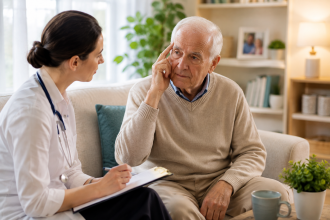
Dementia is a clinical syndrome characterized by a progressive decline in cognitive functions that may affect a person’s independence and ability to perform everyday activities. The difficulties may involve memory, orientation, language, attention, judgment, and executive functions. As the condition progresses, changes in mood, behavior, sleep, and personality may also occur. Many people with dementia, particularly in the more advanced stages, experience mobility difficulties or significant functional dependence, making transportation to a medical clinic or hospital difficult and burdensome. A home assessment for patients with dementia allows neurological and cognitive evaluation to take place in the patient’s familiar environment, reducing the difficulties associated with transportation while also providing valuable information about their actual day-to-day functioning.
Dementia and Cognitive Decline
Dementia is not a single disease but a syndrome that can result from a variety of conditions affecting the brain. Alzheimer’s disease is the most common cause of dementia. Other forms include vascular dementia, dementia with Lewy bodies, frontotemporal dementia, and mixed forms of dementia.
Depending on the cause and stage of the condition, symptoms may include:
- loss of recent memory
- repeatedly asking the same questions
- disorientation in time or place
- difficulty finding words
- problems with comprehension or communication
- impaired judgment and decision-making
- difficulty managing medications or financial responsibilities
- changes in mood and behavior
- apathy or social withdrawal
- sleep disturbances
- walking difficulties and an increased risk of falls
- progressive loss of independence in everyday activities
Indications for Home Assessment of Patients with Dementia
As dementia progresses, attending a medical clinic can become increasingly difficult.
A home neurological examination may be particularly useful when the patient:
- has significant walking difficulties or reduced mobility
- is bedridden or requires assistance with mobility
- has advanced dementia
- becomes significantly disoriented when their environment changes
- experiences behavioral or psychological symptoms
- has an increased risk of falls
- has recently experienced a significant decline in functional ability
- has difficulty cooperating during transportation or while waiting in a medical setting
Assessment at home can also allow the physician to gain a better understanding of how the patient actually functions in everyday life.
Neurological and Cognitive Assessment at Home
The assessment is adapted to each patient’s condition, age, and stage of dementia.
It may include:
Neurological examination: Assessment of mobility, muscle strength, reflexes, balance, gait, and other neurological functions.
Cognitive assessment: Evaluation of memory, orientation, attention, language, and other cognitive functions using appropriate tests when feasible.
Assessment of daily functioning: Evaluation of the patient’s ability to manage basic and more complex activities of daily living.
Assessment of behavioral and psychological symptoms: Symptoms such as agitation, aggression, apathy, hallucinations, sleep disturbances, and behavioral changes are evaluated.
Medication review: The patient’s current treatment is reviewed, including potential side effects and the need for adjustments.
Memory Assessment at Home
When the patient’s condition allows, brief tests can be used to assess cognitive function. Cognitive assessment is not limited to memory. Orientation, attention, language, recall, and other cognitive abilities may also be evaluated. The results should always be interpreted in combination with the patient’s medical history, neurological examination, educational background, and overall functional status.
The Importance of Assessment in a Familiar Environment
One of the important advantages of a home dementia assessment is that the patient can be evaluated within their actual everyday environment.
This can provide useful information about:
- the ability to move safely around the home
- the risk of falls
- orientation within the environment
- the ability to perform self-care
- medication management
- the actual level of assistance and supervision required
- behavior and communication with caregivers
At the same time, remaining in a familiar environment may reduce the anxiety and disorientation that can occur when a person with dementia is taken to an unfamiliar setting.
The Role of Family Members and Caregivers
Family members are often the primary source of care for a person with dementia. During a home visit, relatives and caregivers can provide valuable information about changes in the patient’s memory, behavior, sleep, mobility, and everyday functioning.
Practical issues can also be discussed, including:
- patient safety at home
- fall prevention
- correct medication use
- sleep disturbances
- management of challenging behaviors
- nutrition and hydration
- daily care and supervision needs
Supporting and guiding caregivers is an important part of the overall management of dementia.
Sudden Deterioration in a Patient with Dementia
Not every worsening of confusion is caused by the progression of dementia. A sudden change in mental status or behavior may be associated with infection, dehydration, metabolic disturbances, medication side effects, pain, or delirium and requires medical assessment. If the patient suddenly develops weakness or numbness on one side of the body, facial asymmetry, speech disturbance, a seizure, a significant reduction in the level of consciousness, or other acute neurological symptoms, immediate emergency medical evaluation is required.
Follow-Up of Patients with Dementia at Home
Dementia is a chronic condition, and the patient’s needs change as the disease progresses. Regular reassessment can help monitor cognitive and functional status, evaluate the effectiveness and safety of treatment, and identify new problems at an early stage. A home neurological assessment for patients with dementia can be a particularly useful option for people who have difficulty traveling to a medical clinic. It allows their cognitive, neurological, and functional status to be evaluated within the familiar environment of their own home while also providing guidance and support to family members and caregivers.