
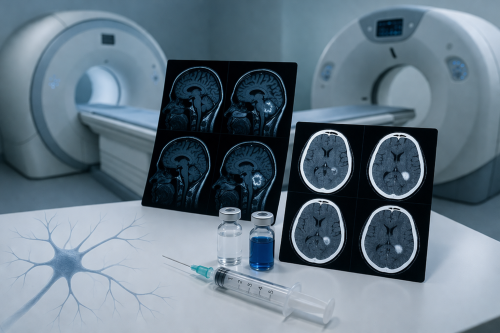
Magnetic Resonance Imaging (MRI) and Computed Tomography (CT) are essential tools in the diagnosis of neurological disorders. In many cases, a contrast agent is used to achieve better visualization of the brain.
What is a contrast agent?
A contrast agent is a special substance that is usually administered intravenously before or during the examination.
Its purpose is to “highlight” specific structures or pathological areas in the brain, making them more visible on imaging.
- In CT scans, iodine-based contrast agents are used
- In MRI scans, gadolinium-based contrast agents are used
Why is contrast needed?
A contrast agent is not required for every examination. However, in many cases, it is crucial for an accurate diagnosis.
Contrast agents help improve the visualization of:
- Brain tumors
- Inflammatory conditions (e.g., encephalitis, abscesses)
- Vascular lesions (aneurysms, malformations)
- Multiple sclerosis (active lesions)
- Metastases
- Disorders of the blood–brain barrier
In simple terms, contrast agents show not only the structure but also the activity of a lesion.
What is the difference in contrast use between MRI and CT?
Magnetic Resonance Imaging (MRI)
- Provides more detailed imaging of the brain
- Contrast helps identify active lesions
- Ideal for conditions such as multiple sclerosis, tumors, and inflammation
Computed Tomography (CT)
- Faster examination, useful in emergency situations
- Contrast helps detect hemorrhages, tumors, and vascular abnormalities
- Commonly used in urgent conditions (e.g., stroke)
Is contrast safe?
For the vast majority of patients, contrast agents are safe and well tolerated.
However, certain situations require caution:
- Allergy to contrast agents (especially iodine-based for CT)
- Kidney dysfunction
- Pregnancy
Side effects are rare and usually mild, such as:
- A sensation of warmth
- Metallic taste
- Mild nausea
Severe reactions are extremely rare.
When is contrast not needed?
In many cases, imaging without contrast is sufficient, such as:
- Simple headaches without neurological findings
- Follow-up of known, stable lesions
- Acute hemorrhage (initial evaluation with CT)
The decision is always made by the treating physician based on the patient’s symptoms and medical history.
Contrast agents are a valuable tool that significantly enhance the diagnostic accuracy of brain MRI and CT scans.
They are not necessary in all cases, but when used appropriately, they can reveal critical information that is not visible on standard imaging.
Proper guidance from a neurologist ensures that each patient undergoes the most appropriate examination, with or without contrast, prioritizing both safety and diagnostic accuracy.