
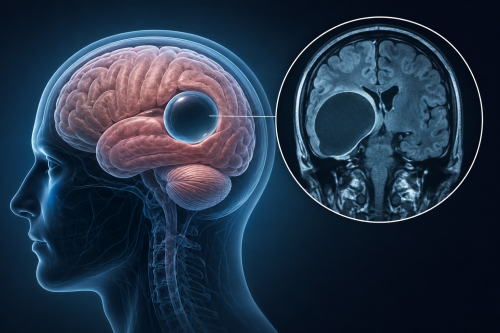
A brain arachnoid cyst is a fluid-filled sac that develops between the brain or spinal cord and the arachnoid membrane — one of the protective layers surrounding the central nervous system. In many cases, arachnoid cysts are discovered incidentally during MRI or CT scans performed for headaches, dizziness, trauma, or other neurological symptoms.
Although most arachnoid cysts are harmless and remain stable throughout life, some may cause symptoms depending on their size and location. Understanding what an arachnoid cyst is — and when medical evaluation is necessary — can help reduce unnecessary anxiety and ensure proper neurological monitoring.
What is an Arachnoid cyst?
An arachnoid cyst is a benign, cerebrospinal fluid-filled cavity located within the arachnoid membrane. These cysts are usually congenital, meaning they are present from birth, although they may remain unnoticed for many years.
Less commonly, arachnoid cysts may develop later in life due to:
- Head trauma
- Brain infections
- Brain surgery
- Bleeding within the brain
- Inflammatory conditions
Arachnoid cysts are not tumors and are typically non-cancerous.
Where are brain Arachnoid cysts usually located?
Arachnoid cysts can appear in different areas of the brain, but they are most commonly found:
- In the temporal region (middle cranial fossa)
- Near the cerebellum
- Around the brainstem
- In the spinal canal
The symptoms depend largely on the cyst’s size and the pressure it places on nearby brain structures.
Symptoms of an Arachnoid cyst
Many arachnoid cysts cause no symptoms at all and are discovered accidentally during imaging studies. However, larger cysts may lead to neurological symptoms such as:
- Headaches
- Dizziness
- Nausea or vomiting
- Balance problems
- Visual disturbances
- Hearing changes
- Seizures
- Cognitive or concentration difficulties
- Weakness or numbness
- Increased intracranial pressure
In children, symptoms may also include:
- Developmental delay
- Enlarged head circumference
- Behavioral changes
- Learning difficulties
Can an Arachnoid cyst cause headaches?
One of the most common questions patients ask is whether their headaches are related to the arachnoid cyst. In many cases, small cysts are incidental findings and are not the true cause of headaches.
However, larger cysts or cysts causing pressure on surrounding brain tissue may contribute to:
- Chronic headaches
- Pressure-like pain
- Headaches associated with nausea or dizziness
A neurological evaluation and imaging review are important to determine whether the cyst is clinically significant.
How is an Arachnoid cyst diagnosed?
Brain arachnoid cysts are usually diagnosed with imaging studies such as:
MRI (Magnetic Resonance Imaging)
MRI is the preferred examination because it provides detailed images of the brain and helps differentiate arachnoid cysts from other abnormalities.
CT Scan (Computed Tomography)
A CT scan may also reveal an arachnoid cyst, especially in emergency settings or after head trauma.
In many cases, follow-up imaging may be recommended to monitor the cyst over time.
Do Arachnoid Cysts Grow?
Most arachnoid cysts remain stable throughout life and never require treatment. However, in some cases — especially in children — cysts may enlarge over time.
Growth may increase pressure within the skull and lead to worsening neurological symptoms.
For this reason, periodic neurological follow-up may be advised depending on:
- The cyst’s size
- Its location
- The patient’s symptoms
- Age of the patient
Treatment for Brain Arachnoid Cysts
Observation and Monitoring
Most arachnoid cysts do not require surgery. If the cyst is small and asymptomatic, regular monitoring with MRI scans may be sufficient.
Surgical Treatment
Surgery may be considered when:
- The cyst causes significant symptoms
- There is evidence of increased intracranial pressure
- Neurological deficits appear
- The cyst continues to enlarge
Possible surgical approaches include:
- Endoscopic fenestration
- Microsurgical fenestration
- Cyst shunting
The appropriate treatment depends on the cyst’s location and the patient’s overall condition.
Is an Arachnoid Cyst Dangerous?
In most cases, arachnoid cysts are benign and do not pose a serious health risk. Many people live their entire lives without symptoms or complications.
Nevertheless, medical evaluation is important when symptoms such as severe headaches, seizures, balance problems, or neurological changes occur.
When Should You See a Neurologist?
You should seek neurological assessment if you experience:
- Persistent or worsening headaches
- Seizures
- Dizziness or balance issues
- Vision changes
- Memory or concentration problems
- Neurological symptoms after head trauma
- MRI findings showing an arachnoid cyst
A neurologist can evaluate whether the cyst is incidental or clinically relevant and recommend the appropriate monitoring or treatment plan.
A brain arachnoid cyst is usually a benign and often incidental finding on brain imaging. While many cysts remain asymptomatic and stable, some may cause neurological symptoms depending on their size and location.
Early neurological evaluation, proper imaging, and individualized follow-up are essential in determining whether treatment is necessary and in providing reassurance and guidance to patients.